
Ben Heidemann from Town & Country Engineering talked to the Argyle Village Board about the funding options for the lead service line drinking water loan.
The village elected to replace all of their lead service lines as part of the lead compliance with the Wisconsin Department of Natural Resources. The village applied and received funding from a subset of the Safe Drinking Water Fund program. What makes this unique is the village has the opportunity to fund both the public and private side of the project. The private side gets funded at a higher rate than the public. The split of the loan between private and public has not been determined. They are hoping the split will be 50/50.
The loans are different for each one. The public side of the loan is 1.5% interest and the private side is .25% interest. The total loan is around $160,000. The loan is closing on May 28. Private is paid for by general obligation pledge, which is using tax as a commitment. They are unable to use water rates or revenue pledge to pay for private. For the public side of the fund, the village had to decide to use general obligation or water rates. Typically it is done by a revenue so that it won’t affect the borrowing limits of the village. The village has already generated enough revenue so they don’t need to have their water rates adjusted again.
Hailee Helfvogt made the motion to put the public portion of the funding under the water rates with Johnny Hinijosa seconding.
The village then had to decide on the length of the borrowing for the private side. For a 10 year loan at .25 percent borrowing, the annual cost would be $8,830. For a 20 year loan at .25 percent the annual cost would be $4,420. Interest on the 10 year loan would be $1,200 and on the 20 year it would be $2,300.
For the public side, they could do a 20 or 30 year loan. For 20 years it would be $5,000 annual payment at 1.5 percent and at 30 years it would be $3,600 annual payment. Interest for the 20 year would be $14,000 and for the 30 year it would be $20,000.
Helfvogt made the motion to do a 10 year loan on the private side and 20 year loan on the public side with Dustin King seconding.
Community center space
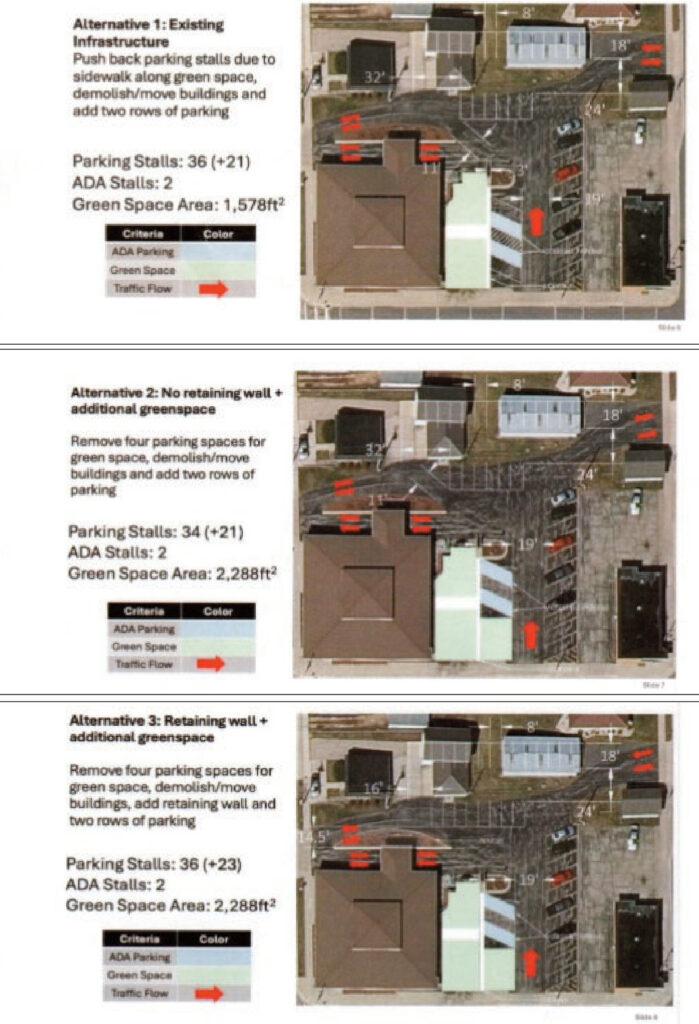
Engineering students from UW- Platteville came to Argyle to look at a space that the village owns to create the best option for the use of the space. Garry Rossing brought those design options to the board to look at. The students will be giving their final report to the Planning Commission and the board in May. These are not designs the village or library are going to be using. They are just designs the students are creating for their senior year projects as they need experience working on a project. Nothing was up for approval and these are by no means a final design.
A couple of issues the Friends of the Argyle Library asked them to look at were an outdoor space and parking. One option was to eliminate the drive thru but several people wanted to keep the space. The students then looked at the space right in front of the entrance just east of the building. The student engineers would like to get an idea of how big of an outdoor space they would like to have. In options two and three were to have a larger green space, eliminating some of the parking. Jenifer Detra, president of the Argyle Public Library Board, commented that the library holds outdoor activities at the park right now so the bigger the outdoor space the better.
The village owns the properties just east of the Pecatonica Valley Leader office all the way to S. Broad Street. A way to maximize the use of those properties was to look at parking. The students came up with ideas of how to create more parking spaces by eliminating both storage buildings, one that was used by the police department and now sits vacant and the other building that currently houses the boat for the Argyle-Adams Fire Department and some fish fry supplies. There have not been any discussions with the fire department at this time.
The other alternative with the parking is eliminating the landscaping north of the drive thru in option 3, put a retaining wall in and create some additional parking and making the flow of traffic a bit easier.
Phosphorus projects
President Tom Moore asked Heidmann about the proposed water quality trading (WQT) project happening on Gabioud’s land.
Heidemann stated that the DNR was waiting for a heavy rainfall so they could see if there is a heavy flow of water off of their barnyard.
The village has issued their public intent to have their permit for the WWTP reissued. That permit is available to look at on the DNR website. The village has applied for a multi-discharger variance (MDV) for phosphorus for this permit term and that application has been approved by the DNR. With an MDV, the village is limited to 1.0 mg/L of phosphorus to be discharged. They are required to report the total amount of phosphorus discharged in lbs/month and Ibs/year. Then March 1 of each year they shall make payments-to counties within the watershed-of $68.40 per pound of phosphorus discharged during the previous year in excess of the target value of .2 mg/L.
To be able to reach those limits, Heidemann said that there will need to be some level of treatment of the water done at the WWTP. This will need to happen over the next four years. They are currently discharging 5-10 mg/L of phosphorus.
The village previously had an individual permit. Individual Wisconsin Pollutant Discharge Elimination System (WPDES) permits are issued to municipal and industrial facilities discharging to surface water and/or groundwater. The village is extending its timeline for complying with the low-level phosphorus limits. They haven’t found enough WQT to support the individual permit. The MDV is an easier application process but has specific rules. From what the village discharges today, they could be making a $60,000-$70,000 payment to the county each year. The money will come out of the village’s sewer account. That amount gets spread out between the counties involved.
Adding the chemicals to the WWTP makes the payment to the counties decrease by over 50 percent. If the village didn’t add the chemicals, weren’t able to decrease the phosphorus discharge with WQT credits, and didn’t have the MDV, they could be looking at building a whole new WWTP, which could cost around $4 million.
The WWTP was built in 1991. Heidemann stated that upgrading the plant should be on the village board’s radar. He said they should do some facility plan in place so they are able to get some funding from the DNR when they need to get some additional upgrades done. Heidemann didn’t think they would need to do any expansion just upgrades. They have a lot of capacity and the concrete is good. He said the sludge holding tanks may need to be looked at.
Recycling hours
Recycling Center employee Gary Mckibben is not a fan of the village’s new hours on Wednesday of 11 a.m. – 5 p.m. He would like to go from 9 a.m. – 3 p.m. Current hours are 9 a.m. – 12 p.m. with a break and then back from 4 p.m. – 7 p.m. Mckibben stated he doesn’t want to stay until 5 p.m. but he also doesn’t want to give up his hours. The village doesn’t want to get rid of the evening hours for those members of the village that have to work and can’t make it during the day. The board talked about possibly having someone sit at the recycling center during the evening hours. The discussion was tabled.
Other business
A question was brought up about if a permit is needed to change/update a driveway or sidewalk. It was discussed that if the portion of the driveway that connects to the house is being worked on, it will need a permit. The board felt the ordinance should be changed stating the person should have to contact the village’s building inspector Scott Jelle. The board tabled the discussed to see about changing the ordinance.
There was damage done to a water box near the duplexes being built by Garthwaites on the old school lot. The cost is $5,984. Hinijosa made a motion that the bill should be sent to the person who applied for the permit with King seconding. That will be the rule going forward that any damages to village property done on a project will be charged to the person who applied for the permit.
Action items
The board also approved:
- contracting with Vierbicher for nine hours a month for $175/hour for 2026.
- giving Jared Johnson a pay raise of 2 percent until they review contracts again at the end of the year. – selling the forklift at Wisconsin Surplus for $850.
- the Johnson Block engagement letter for audit.
- Val Steiner as an Argyle Library board member, filling the vacant position.
- televising pipes for $19,250 – purchasing UV lamps for $2,050.
- the new dumping permit for the haulers at the WWTP.